The Problem
Mid-sized enterprises in Saudi Arabia and the UAE face an increasingly sophisticated threat landscape, but most lack the budget for a full SOC (Security Operations Center) team. They were receiving raw log data from their infrastructure — firewalls, servers, cloud services — but had no way to visualize, correlate, or act on it in real time. Security events were being reviewed hours after they occurred, if at all.
The NCA (National Cybersecurity Authority) in Saudi Arabia had also introduced compliance requirements that these organizations needed to demonstrate adherence to. Manual compliance reporting was consuming two to three days of IT staff time per quarter.
What We Built
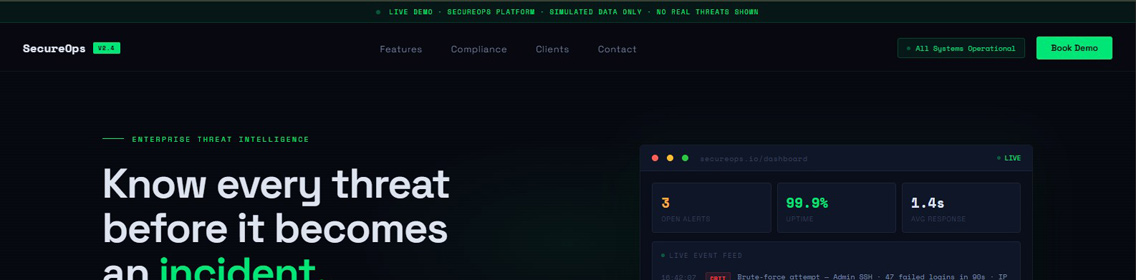
SecureOps is a multi-client security monitoring platform that ingests security events via API, correlates them in real time, and surfaces actionable alerts through a WebSocket-driven dashboard. Each client organization gets an isolated view of their own security events, with role-based access for security analysts, IT managers, and C-suite stakeholders who need executive summaries rather than raw event streams.
The compliance reporting module generates audit-ready reports for ISO 27001 and NCA requirements on demand — what previously took days now takes minutes.
Core Features
WebSocket-powered live dashboard. Security events appear within 200ms of ingestion — no page refreshes, no polling delays.
REST API ingest from any SIEM that supports outbound webhooks. Pre-built connectors for Splunk, IBM QRadar, and Microsoft Sentinel.
Rule-based alert engine with Slack, email, and WhatsApp notification channels. Escalation rules, acknowledgment workflows, and on-call rotation support.
One-click compliance report generation. Control mapping, evidence collection, and audit trail — formatted to NCA and ISO 27001 standards.
Managed security service providers can oversee multiple client environments from a single interface with complete data isolation between tenants.
High-level security posture view for non-technical stakeholders. Risk score, open incidents, trend data — no raw log feeds.
Technical Architecture
The event ingest layer is built on Laravel with a dedicated ingest API that accepts events from any source that can POST JSON over HTTPS. Events are validated, normalized to a common schema, and pushed to a Redis stream for processing. A background worker consumes the stream, applies correlation rules, and writes processed events to PostgreSQL while pushing real-time notifications to connected WebSocket clients via Laravel Reverb.
The WebSocket architecture was a deliberate choice over server-sent events (SSE). SSE would have been simpler, but the alerting system required bidirectional communication — analysts need to acknowledge alerts and update incident status from the same interface that's showing them the live feed.
Infrastructure is deployed on DigitalOcean with Cloudflare in front. Database replication to a read replica handles the reporting query load without affecting the real-time ingest performance. All data at rest is encrypted; data in transit uses TLS 1.3 exclusively.
The Result
The platform reached 12 enterprise clients within four months of launch, including two organizations that were directly referred by NCA-affiliated contacts after seeing the compliance reporting capabilities. Post-launch security incident count on the platform itself is zero — a requirement we set as a non-negotiable engineering standard given the nature of the product.
The average time to generate a quarterly ISO 27001 evidence report dropped from approximately two and a half days to under 15 minutes for clients using the platform.