The Problem
The client operated a network of general practice and specialist clinics across Abu Dhabi and Dubai. Appointment management was running across a combination of a legacy Windows desktop software, WhatsApp groups, and paper registers — a system that had grown organically and was actively causing problems: double-bookings, an 18% no-show rate with no automated reminder capability, insurance verification done manually by front desk staff, and no ability for clinic managers to get a consolidated view across locations.
Patient data was stored in ways that didn't meet the UAE's Health Data Governance guidelines — a compliance risk the group's legal team had flagged as urgent. Any solution needed to address data security as a first-class requirement, not as an afterthought.
What We Built
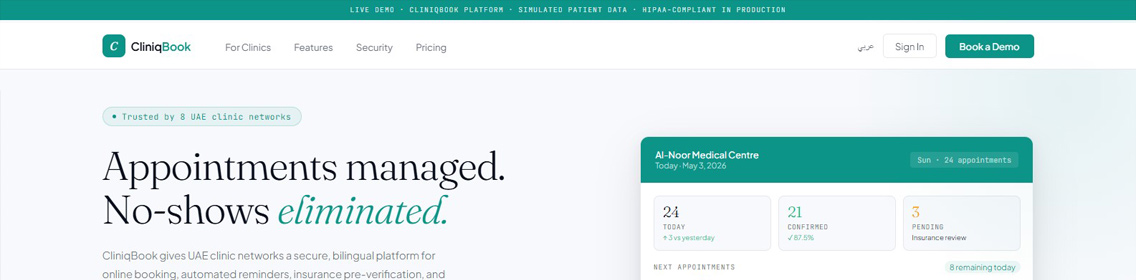
A multi-location appointment and patient management platform with three distinct interfaces: a patient-facing booking portal, a clinical staff dashboard, and a clinic manager admin panel. All three share a single database architecture with row-level access controls that enforce strict separation between clinics, patients, and staff roles.
Patient health data is encrypted at the field level using application-layer encryption — not just at-rest database encryption. This means that even a full database export contains no readable patient records without the application's encryption keys, which are managed separately from the database servers.
Core Features
Patients book in under 2 minutes. Real-time slot availability across all 8 clinics. Doctor profile pages with specialization, languages spoken, and available slots.
SMS and email reminders 48 hours and 2 hours before appointments via Twilio. One-tap cancellation and rescheduling from the reminder message — no login required.
Pre-appointment insurance data collection and verification workflow. Front desk staff review pre-submitted insurance details before the patient arrives, eliminating walk-in delays.
Field-level encryption on all patient health data. Access audit logs on every record view. Compliant with UAE Health Data Governance Guidelines and DHA data requirements.
Clinic managers see appointment volumes, no-show rates, and doctor utilization across all locations in real time. Exportable reports for operations and board reporting.
Arabic RTL and English patient interfaces. Language preference saved to patient profile. SMS reminders sent in the patient's chosen language.
Security Architecture
Healthcare data requires a different security posture than typical web applications. We applied three layers of protection beyond standard Laravel security practices.
First, field-level encryption using AES-256 on all patient identifiers, health record summaries, and insurance data. The encryption key is stored in a separate secrets manager (HashiCorp Vault), not in the application's environment file. Second, all API endpoints are authenticated using short-lived JWT tokens with a 15-minute expiry and a refresh token rotation system. Third, every access to a patient record — read or write — is logged to an immutable audit table that cannot be modified or deleted by any application-level operation.
We also applied OWASP Top 10 hardening throughout: parameterized queries everywhere, strict CSP headers, rate limiting on booking endpoints, and a penetration test by an independent security firm before launch. The test found two medium-severity findings, both remediated before go-live.
The Result
The no-show rate dropped from 18% to under 7% within the first month — a direct result of the automated reminder system. For a network seeing 2,000+ appointments per day, a 65% reduction in no-shows translates directly to revenue recovered and clinic capacity used efficiently.
The insurance pre-verification workflow eliminated the most common front desk bottleneck. Average patient check-in time dropped from 8 minutes to under 3 minutes. Clinic managers report spending 4 hours per week instead of 12 on operational reporting.
Post-launch data security audit by the group's legal team found full compliance with UAE Health Data Governance Guidelines — removing the compliance risk that had initially triggered the project.